-
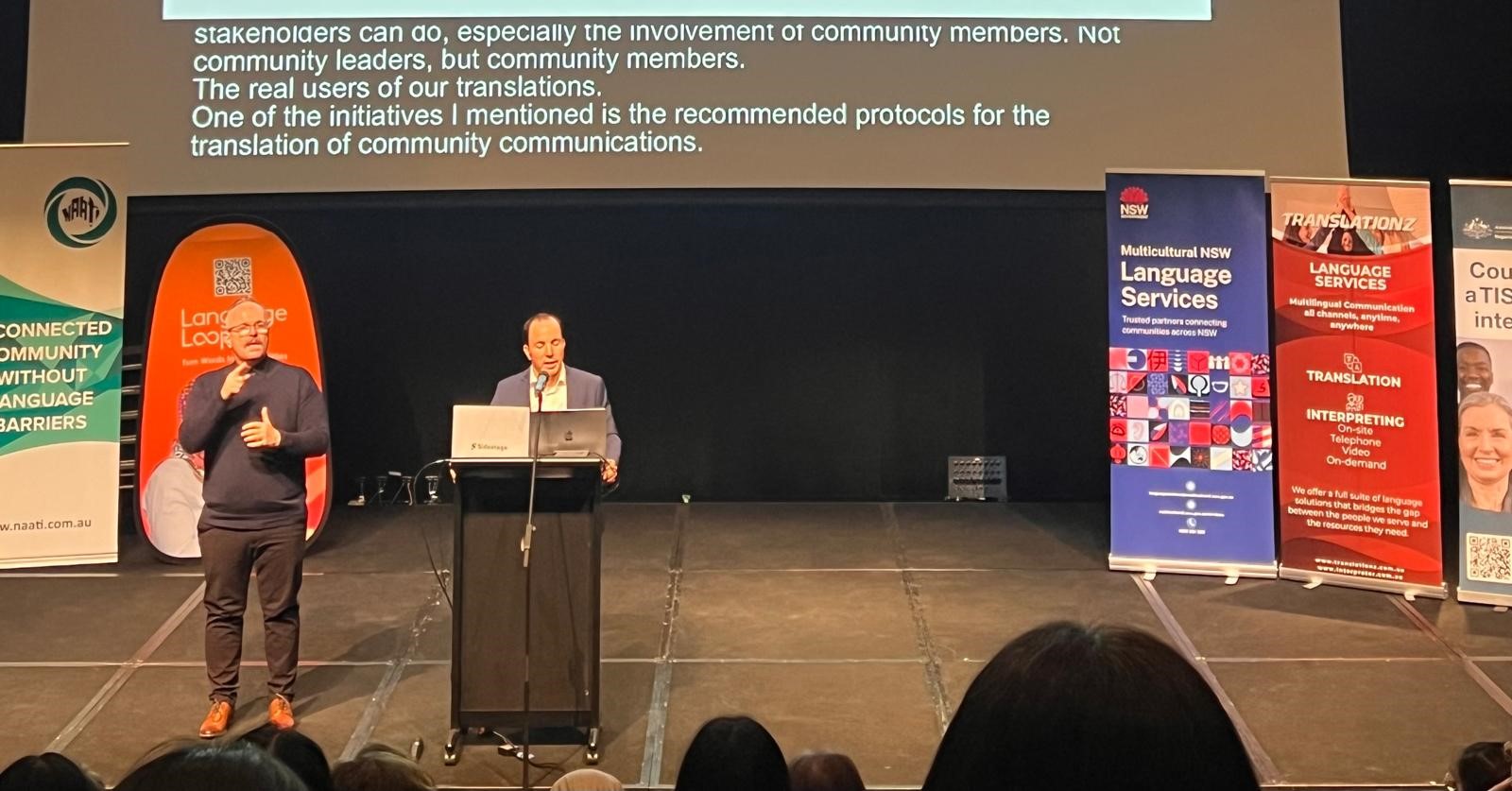
Auslan interpreter during a keynote at the 38th AUSIT National Conference. (2025, November).
How to ensure that no voice is left unseen or unheard?
Although nearly 20,000 Australians use Auslan, the Australian Sign Language, every day, this uniquely Australian language remains unfamiliar to many. In 1991, the Australian Government officially recognised Auslan as a language in its own right. Auslan was developed by and for Australians who are Deaf or hard of hearing. It relies on a rich combination of handshapes, movement, facial expression, and spatial grammar. With its own linguistic structure, entirely separate from English, Auslan is a visual-gestural language that conveys meaning through movement rather than through word order.
Auslan interpreters work in much the same way as spoken-language interpreters, and the Australian Institute of Interpreters and Translators (AUSIT) plays a central role in the profession, hosting the annual AUSIT National Conference each year, with this year’s event held in Canberra from 20–22 November. Translationz was once again proud to serve as the Auslan Accessibility Sponsor.

Virtual healthcare is evolving fast, and Translationz is ensuring interpreting keeps pace. By bringing together advanced technology, integrated systems, and responsive workflows, Translationz has made on-demand video interpreting as seamless and reliable as a face-to-face conversation.
Through an innovative redesign of workflows and the integration of advanced technology, Translationz has developed a next-generation On-Demand Video Interpreting solution that is now live within Victorian Virtual Emergency Department.
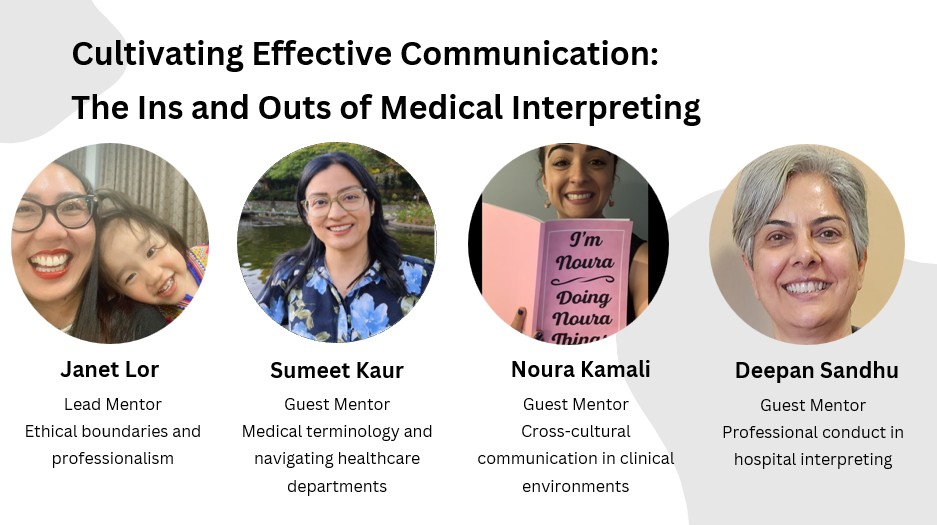
At Translationz, we take a structured and supportive approach to mentoring and training interpreters, particularly those working in new and emerging languages. Our process focuses on building confidence, ethical awareness, and subject-matter expertise through guided mentorship and ongoing professional development.
In May, we delivered a 4-week Medical Mentorship Program designed to strengthen interpreter readiness for complex healthcare environments. Each week focused on a key area essential to quality interpreting:
- Week 1: Ethical boundaries and professionalism
- Week 2: Medical terminology and navigating healthcare departments
- Week 3: Cross-cultural communication in clinical environments
- Week 4: Professional conduct in hospital interpreting
Led by experienced mentors, including NAATI-recognised practitioners, the sessions combined real-world case studies, interactive discussions, and practical skill-building. This model has become a cornerstone of how we mentor interpreters across all language groups, including those working in emerging or low-demand languages.
Interpreting services. The communication of one language to another. The aim these services seek to provide for clients is a simple one: to allow our clients to be fully understood by others.
As with anything in practice, the difficulty in service delivery can be rapidly compounded by everyday factors, just as even in regular conversation between speakers of the same language, anyone can be prone to errors in speech or meaning.
Whether it is the use of idioms, colloquialisms, misunderstandings of words and their use, the constant evolution of language, or some combination of one or all the above misinterpretations are commonplace in our day-to-day lives.
National Overview
In 2021, 22.3% of Australians reported speaking a language other than English at home. More than 300 languages are spoken across the country, underscoring how critical language access is for services, government, health, and community support.
Source: Australian Bureau of Statistics, Census 2021
National Top 10 Languages (excluding English)
According to the 2021 Census, the top languages spoken at home are:
Mandarin, Arabic, Vietnamese, Cantonese, Punjabi, Greek, Italian, Filipino / Tagalog, Hindi, Spanish
